
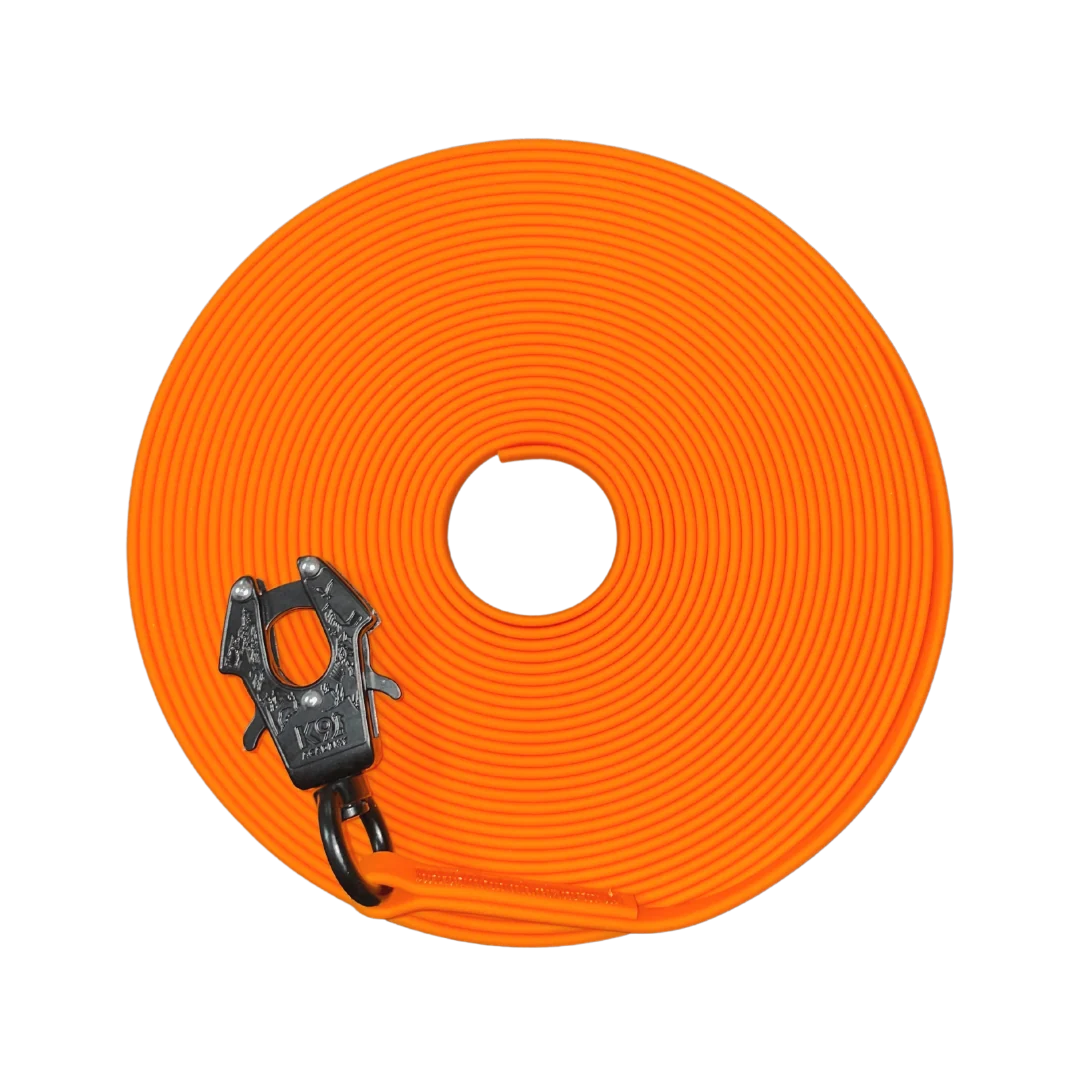
Why a long line beats a longer leash
Zibi is a 35-pound English field gun dog. Field gun dogs were bred to range after birds, all day, without getting tired. Our regular walks take us through parks, trails, and fields where a standard 6-foot leash turns an energetic dog into a frustrated ping-pong ball. Evaluating this category as both a daily dog walker and a procurement professional, the long line is the highest-value piece of walking gear I know — and this 30-foot model is the one I'd spec.
A quick explainer if you haven't used one: a long line isn't a retractable leash (those are a different, worse thing — thin cord, no control, rope burn). It's a fixed-length, wide, flat training leash that gives your dog room to sniff, explore, and be a dog while you keep full control. Trainers use them for recall work; for high-energy breeds, they're a daily essential.
Who this is for
Anyone with an energetic dog who wants to offer real freedom in parks and on trails without going off-leash — recall trainers, hikers, owners of sniff-driven breeds, and anyone working through the "my dog ignores me past 20 feet" phase. Not for crowded sidewalks (reel it in) or tie-out use (never tie a dog out on a long line unsupervised).
What I like
- The length is the sweet spot. 30 feet is enough for genuine exploration — the dog can work a whole field edge — but short enough that I can gather it in quickly when a cyclist or another dog appears. Shorter lines (15 ft) don't give enough freedom; 50-footers become a tangling liability.
- The grip is the point. K9 Academy builds this line from woven nylon with a dual rubberized texture — an anti-slip grip designed to keep the line secure in your hands while you gather and release it, wet conditions included. That handling security is exactly where a long line earns its keep: the line has to stay controllable at the moment a cyclist or another dog appears. The maker also builds the woven construction to resist fraying and stretching under heavy use, and there is a high-visibility stripe woven in for low light.
- Light but strong. The whole point of a long line is that the dog barely notices it. At this weight and width, a 35-lb dog forgets it's there, while the hardware is properly scaled for a strong dog lunging after a squirrel.
- The price. $55.95 CAD from a Canadian company. That puts it squarely in the same band as the premium lines below, so the case for it is not a bargain-basement price — it is the spec: 30 feet, a grippy woven build, and hardware scaled for real dogs, without paying extra for heavier working-dog builds you may never need.
What I do not
- It requires technique. Your first week with a long line, you will step on it, it will wrap around your legs, and you'll wonder what you've done. Watch one 5-minute handling video (there are dozens), learn to gather loops in your hand, and it becomes second nature. This is a skill product, not a plug-and-play product.
- Not for every environment. Busy multi-use paths, farmers' markets, patios — reel it to 6 feet or switch to a regular leash. A 30-foot line in a crowd is a tripping hazard and inconsiderate. Use the right tool for the setting.
- Check the clasp size. Make sure the bolt snap suits your dog's size and your harness/collar ring. For a 35-lb dog the standard hardware on this line is appropriately scaled — for a 90-lb powerhouse, confirm the hardware rating before buying.
How it compares
vs. retractable leashes (~$25–40): Not the same product, despite the similar price. Retractables teach pulling (constant tension), offer no real control, and the thin cord is a burn/cut hazard. Trainers universally prefer long lines. If you currently use a retractable, switching is the upgrade.
vs. premium biothane long lines (~$60–75): Brands like Viper and various custom makers offer heavier-duty biothane with brass hardware. They're excellent — genuinely tougher — but for daily walking and recall training (as opposed to Schutzhund or K9 work), the K9 Academy line covers daily walking and recall training at essentially the same money. The real difference is the build brief: those are heavier-duty biothane with brass hardware, aimed at working-dog use; this one is a lighter woven-nylon line with a rubberized grip, aimed at everyday training. Pay for the duty level you will actually use.
Verdict
Buy it if: your dog needs more freedom than a 6-foot leash allows, you're working on recall, or you hike/walk trails regularly.
Skip it if: you only walk quiet suburban sidewalks (a regular leash is fine), your dog has perfect off-leash recall already (congratulations), or you won't learn the basic handling — an unused long line is just a tangled rope in your closet.
This is the highest value-per-dollar pick in this whole review series. Full transparency on the basis: this one is my professional evaluation — an expert evaluation, not a hands-on ownership review — and on specs and price, it is still the line I would spec first.