
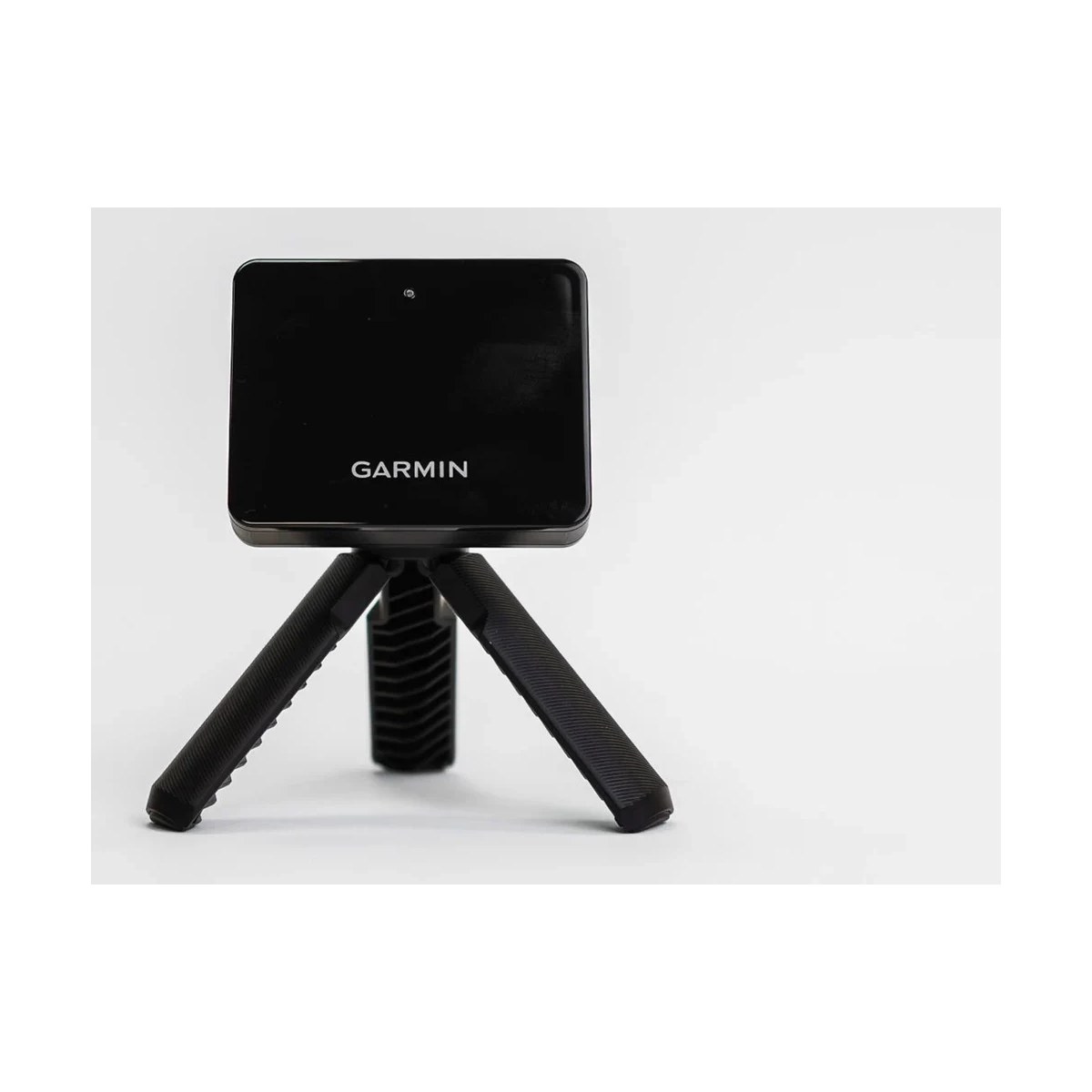
The product, straight up
The Approach R10 is a Doppler radar launch monitor the size of a paperback — about five ounces — that sits 6 to 8 feet behind the ball, pairs with the Garmin Golf app on a phone or tablet, and tracks 14 metrics. Before it arrived, simulator-capable launch monitoring started at several thousand dollars; Garmin brought it in under the four-figure line, and five years on, every competitor in its class is still answering the product it defined. This is an expert evaluation — from a former professional golfer and teaching professional who has practised and taught on launch-monitor data for years — not a hands-on ownership review, and it is judged on a professional's questions: which numbers are measured, which are estimated, and what the full setup honestly costs.
What it does well
The measured numbers are the ones practice runs on. Ball speed, club head speed, launch angle, launch direction, smash factor, carry — radar measures ball flight directly, and the independent testing consensus is that the R10's core ball-flight numbers are trustworthy for practice: dispersion charts, gapping sessions, swing-change feedback. For the actual work of a Canadian winter — grooving a move, learning your real carry numbers, keeping a swing alive until April — those are the metrics that matter, at the range, in the backyard, or into a garage net.
The core product is subscription-free. The launch-monitor functions — driving range, metrics, shot tracking — work without any membership. The Garmin Golf membership (CA$12.99/month or CA$129.99/year on the Canadian App Store) buys Home Tee Hero virtual course play on 42,000+ courses. Data is yours; entertainment is rented. A golfer who skips course play pays nothing per year, ever.
Portability is real. Ten hours of battery, a magnetic tripod, a phone mount that clips to the bag, IPX7 water resistance, and a case about the size of a ball box. The unit behind your garage net in February goes to the range in spring and on a golf trip in summer.
The RCT pairing is the smart upgrade. Garmin and Titleist spec Pro V1 and Pro V1x RCT balls — a version with an internal radar-capture marking — as improving the R10's indoor spin accuracy by up to 30x and carry accuracy by up to 50%. One honesty note, because this site reviews the standard Pro V1: the RCT is a separate SKU, not the ball in that review — and indoors, it is the single most effective upgrade an R10 owner can buy.
What it doesn't do
Indoor spin is calculated, not measured — the defining limitation. A radar watching eight feet of flight cannot directly read spin the way it reads ball speed; the R10 estimates it. Outdoors, with full flight, spin data firms up. Indoors — the exact use case a Canadian winter buyer is purchasing — spin is the number most likely to be wrong, especially on partial wedges and mishits. The mitigations are real (RCT balls above; treating indoor spin as a range, not a reading), but a buyer whose winter plan is dialling in wedge spin indoors is buying the wrong instrument.
The room is a hard requirement. Six to eight feet behind the ball, at least eight feet of ball flight to the net — roughly five metres of depth — plus ceiling height for a full swing. Cold is a Canadian line item too: the rated operating floor is around −10°C, and an unheated garage in January can sit below it. Measure the room before the money moves; the geometry is the product.
The unit is not the bill. Add a net or screen, a mat you won't hurt your wrists on, the optional membership if you want course play, and RCT balls as a consumable — the first-year total lands well above the unit's price, and still beats a winter of rented sim-bay hours for a golfer who will genuinely use it three nights a week. But it is a build, not a box, and should be budgeted as one.
What it does well
- Measured core numbers — ball speed, launch, carry and dispersion you can practise on.
- Subscription-free core — membership buys course play only.
- Truly portable — 10-hour battery, IPX7, bag-sized case.
- Category-defining value — simulator golf under four figures.
What it doesn't do
- Measured indoor spin — it is calculated, and it is the main Canadian use case.
- Small rooms — needs about five metres of depth and swing height.
- Standalone use — your phone or tablet is the entire interface.
How it compares
vs. Rapsodo MLM2PRO: the step-up indoor rival — radar plus cameras that measure spin on marked balls, at the next price tier, with its own membership economics. If indoor spin truth is the priority and the money stretches, it is the honest alternative. vs. the camera class (SkyTrak+, Mevo+, Garmin's own R50): a different league at roughly three to eight times the price, anchoring permanent sim rooms. If your build is a working garage, the R10 is why you don't have to go there.
Verdict
Buy it if: you have the five metres, you will practise more than you play virtual rounds, you accept indoor spin as an estimate (or plan for RCT balls), and you run the total-cost audit with your eyes open.
Skip it if: your space is short or your ceiling is low, or your winter goal is precise indoor wedge spin without RCT balls — a sim-studio membership is the honest buy in that case.
Price shown is the Golf Town price, checked on golftown.com on November 25, 2026, and may change. This is an expert evaluation based on the published spec and independent testing consensus — not an ownership review.
Related reviews: Titleist Pro V1 — and the RCT note above · Golf Electronics — the rangefinders and GPS units reviewed alongside it.
My rating: 8.5/10 — half a point for calculated indoor spin sitting exactly on this product's main Canadian use case, half for the room and build-out demands the sticker price doesn't mention, half shared for course play being a perpetual rent. What earns it back: measured numbers you can practise on, a subscription-free core, real portability, and a value position five years of competitors haven't displaced.
CA$549.98 at Golf Town
Direct retailer links. Prices were the checked prices at review time; the retailer page always shows today's.