
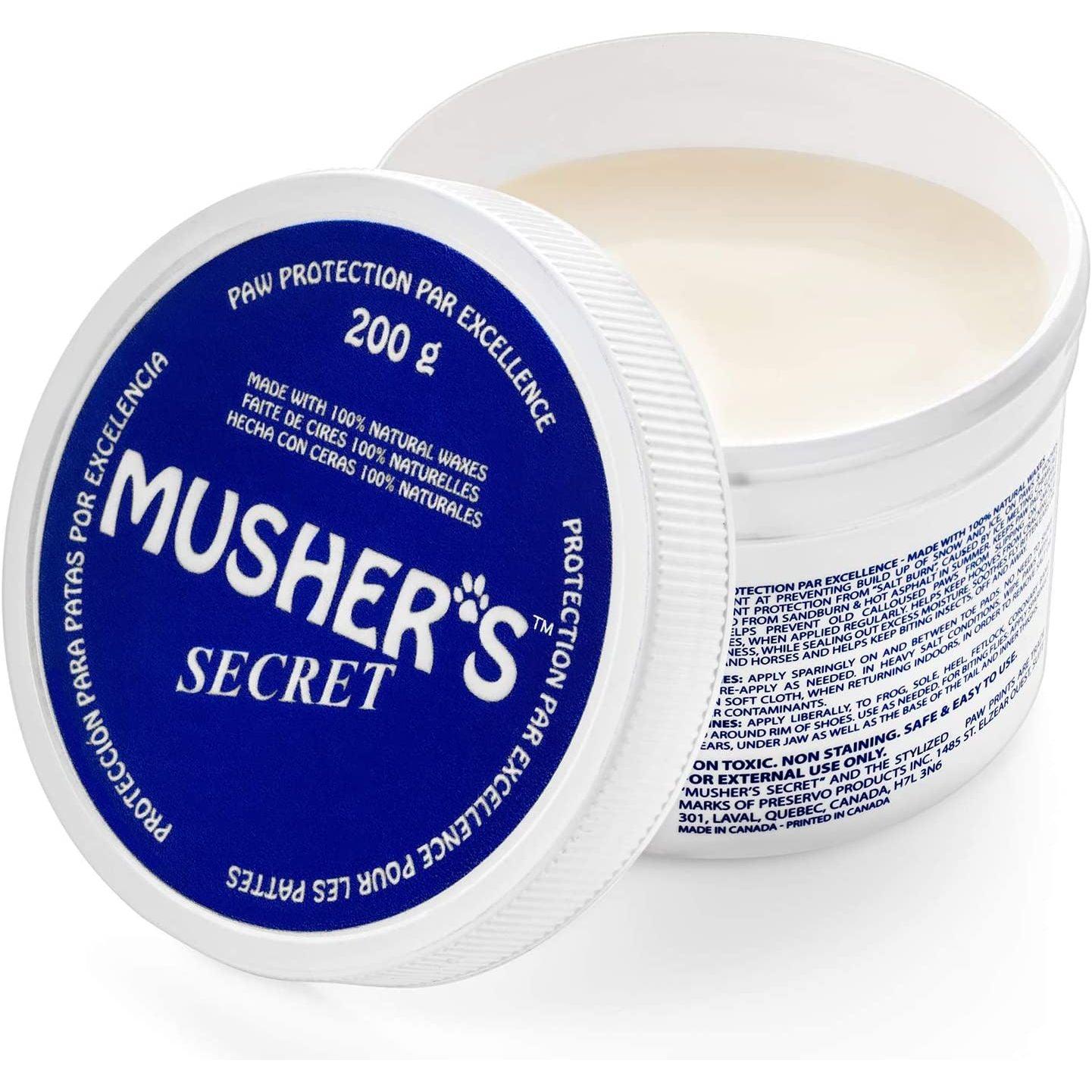
An expert evaluation — and a disclosure that matters
Start with the disclosure, because it's the whole reason this review exists in this form: Musher's Secret is not in my kit. I don't use paw wax on my dog — my standing objection is the residue it can track onto floors, and it's printed in full below rather than smoothed over. What I do have is 16-plus years in procurement — evaluating products on formulation, design intent and field evidence rather than marketing — and a winter walking routine of roughly 10,000 steps a day with Zibi, a 35-pound English field gun dog, in a climate where road salt, ice and refrozen slush are a four-month reality. Paw protection is a problem I have to solve every winter; I solve it my way. This is the product the serious winter crowd solves it with, and it earns an honest evaluation on the evidence — including the reasons it's not the choice in this house.
Who this is for
Dogs who work and play hard in real winter: sled dogs (it was developed for Canadian sled dogs), hunting and hiking dogs, and any dog logging long miles on ice, packed snow and salted sidewalks. It's the front-line recommendation for the two problems boots solve badly — snowballing, snow packing and freezing between the toes, and pad damage from ice, salt and frozen grit — and it's the standard answer for dogs who flatly refuse boots. If your winter is three slushy weeks and a short walk to the corner, you don't need musher-grade anything.
What it does well
The formula is the product. Four waxes — white and yellow beeswax, carnauba, candelilla — plus food-grade oils and vitamin E, forming a semi-permeable barrier on the pad. Moisture and irritants stay out; the pad can still breathe. That's an engineered shield, not a moisturizer with good branding, and it's why the formula has survived essentially unchanged while a hundred paw balms have come and gone.
It is the standard pick for snowballing. Wax on the pads and worked between the toes denies snow the grip it needs to pack and freeze. Owner reports are remarkably consistent across thousands of reviews: dogs that used to stop mid-walk to chew ice out of their feet just keep walking. For spaniel-type feet with feathering between the toes — exactly the feet that ball up worst — this is the use case the product was born for.
Salt and ice protection is the other half of the job. The barrier keeps road salt and de-icing chemicals off the pad skin — where the cracking, licking and limping actually come from in city winters. Pairs with the ICETRAX cleats in the winter walking kit: traction for the human, barrier for the dog.
It's food-grade and lick-safe. Every ingredient is food-safe. A dog that licks its paws after application is not a poisoning scenario. For a product applied to an animal that grooms itself, that safety profile is table stakes, and a lot of cheaper balms can't say it as cleanly.
A tub lasts. A little goes a long way — the 60 g tub (CA$19.99 at PetMax) is the sensible first buy; the 200 g (CA$30.99) is the season-plus supply for one dog at two or three applications a week. The cost per winter is trivially small against a single vet visit for a split, infected pad.
What it doesn't do
Full disclosure: it can track onto your floors — and that's why it's not in my kit. Reviewers who love this product say it too: over-apply it and you'll get residue, paw prints and slick spots on hard floors until it absorbs. The consensus fix is consistent — a thin layer, applied at the door, right before the walk, so the wax absorbs and wears where it's supposed to: outside. I keep a wax-free house as a matter of preference; plenty of serious winter walkers accept the two-minute door routine as the price of protected feet. Both positions are reasonable. Know yours before you buy.
It's a barrier, not a boot. Wax adds no traction on ice and no puncture protection against glass or sharp ice edges. A dog working sharp, broken terrain still needs physical coverage.
It needs reapplying. Two or three times a week in regular use, more in deep cold or heavy salt. It's a maintenance product, not a fit-and-forget one — budget the habit, not just the tub.
How it compares
vs. dog boots: boots give physical protection and lose on acceptance — a meaningful share of dogs will not keep them on, and every boot owner has a lost-boot story. Wax inverts the trade: total acceptance (there's nothing to kick off), real chemical and snowballing protection, no physical armour. For a boot-refuser, this isn't the consolation prize; it's the correct tool.
vs. budget paw balms: the budget balms moisturize, and some are fine for dry pads in mild weather. What they generally don't match is the four-wax barrier density and the sled-dog field record. Musher's Secret — from a third-generation Canadian family business — is the one the working-dog world standardized on.
vs. doing nothing (free): defensible for short winter walks on cleared sidewalks. The bill arrives as cracked pads, salt irritation and a dog chewing ice balls out of its feet at 10 p.m. Prevention is a twenty-dollar tub.
What it does well
- The four-wax barrier. Beeswax, carnauba and candelilla with vitamin E — the engineered formula the category is judged against.
- The snowballing record. The standard pick, on a mountain of consistent owner reports, for the feet that ball up worst.
- Food-grade and lick-safe. The safety profile a paw product should have, stated cleanly.
- Cost per winter. A tub is a season of protection for less than one vet visit for a split pad.
What it doesn't do
- The floor caveat — my reason. Over-applied, it tracks. The thin-layer-at-the-door routine is the fix, and it's a real condition of ownership.
- No traction, no armour. A barrier is not a boot; sharp terrain still needs physical coverage.
- A reapplication habit. Two to three times a week in real winter — maintenance, not fit-and-forget.
Verdict
Buy it if: your dog logs real winter miles, comes home with snow packed between the toes, walks salted streets daily, or refuses boots on principle. This is the proven, musher-grade answer, and it's the paw product I'd point any serious winter walker to first.
Skip it if: you can't accept any paw product near your floors even with the door routine — that's my own position, honestly held — your dog needs puncture protection (buy boots), or your winters are mild and brief.
My honest position: this is the first jar I'd reach for if my own paw-care routine ever stops being enough. It isn't in the kit today for one disclosed reason, and that reason is in this review rather than smoothed over, because that's how this site works.
Prices shown are the PetMax Canada prices at review time (November 11, 2026) — 60 g CA$19.99, 200 g CA$30.99 — and may change.
My rating: 9/10. As an evaluation: the formula, the snowballing record and the safety profile are best-in-class; docked one point for the reapplication habit and the floor caveat that over-application earns.
CA$19.99 (60 g) at PetMax Canada
Direct retailer links. Prices were the checked prices at review time; the retailer page always shows today's.