
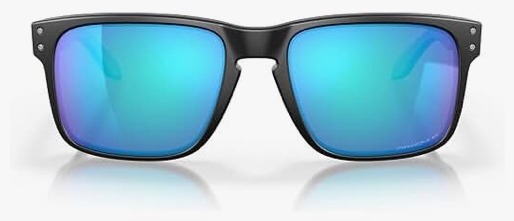
Which pair is which — read this first
This review is about a lens, so let's be exact about the hardware.
Mine: Oakley Sylas (OO9448), a custom build in size 57, with the Prizm Sapphire Polarized lens. I've owned six pairs of them. My exact replacement lenses have been discontinued — Oakley confirmed that to me in writing in September 2026, during a warranty case, and fitted an in-stock equivalent Sapphire Polarized lens (OO9448-2857) instead. That equivalent is what I'm wearing now.
The pair linked below: Oakley Holbrook (OO9102) with the Prizm Sapphire Iridium Polarized lens, 57 mm. Slightly different frame than mine — but almost exactly the same where it counts: the same Sapphire polarized lens family, and the same all-plastic build (O-Matter frame, Plutonite lenses, no glass). It's the closest version of my glasses that Amazon actually sells, which is why it's the link.
Want my exact frame instead? The Sylas is still sold through Canadian optical shops — seen around CA$253 — just not on Amazon. No link; go to an optician.
Everything below — the score included — is a verdict on the lens and the platform I've worn for years, not on a frame I've never put on.
Why I'm qualified to judge this lens
I wore high-end designer sunglasses for years. Good glass, famous names, the lot. Then I switched back to Oakley — deliberately — because my life is athletic: golf, fishing, and a daily waterside walk with a 35-pound English field gun dog who does not care what the weather is doing. Designer frames are jewellery that happens to block light. I needed equipment.
Since the switch, I have bought the same Oakley lens six times. Not six different models — the same Prizm Sapphire Polarized lens, in the same all-plastic Sylas frame, over and over. I've now worn it on the golf course, on the water, and on thousands of shoreline walks, in the city and up north. When someone rebuys the identical lens that many times, through every excuse to try something else, that's not brand loyalty. That's a test result. Here's the honest breakdown.
The six pairs — where they all went
People ask why anyone owns six pairs of the same sunglasses. Fair question. The short answer: the losses were mine, not the glasses' — and after every single one, I bought the same lens again.
One pair is in a small lake. Gone over the side, into water I could see straight down into — which is the lens working as advertised, right up until it was the thing in the water. Nothing to do but watch it sink and order another pair. Which I did.
One pair is somewhere at a dog park. It fell off my shirt — I'd hung it from the collar, the way everyone does — somewhere between the gate and the car, and it never turned up. That loss taught me the lesson I now walk by: sunglasses ride in the bag, not on the shirt. These days they live in my YETI Sidekick Dry on walks, zipped in, and I haven't lost a pair since.
One pair got chewed. Zibi got her mouth on them at about six months old — the one and only thing she has ever really chewed up. She went for the lenses, and the lenses lost. I sent that pair through Oakley's warranty process and got replacement lenses fitted (that's the September 2026 case in the box above — the exact original lens had been discontinued, so Oakley fitted the in-stock Sapphire Polarized equivalent), and that same pair is still in service. A chewed-up pair of sunglasses that is still being worn tells you most of what you need to know about the build.
Two pairs are in everyday use right now — one for the daily walks and golf, one in rotation. And I'll be honest that the casualty list above is the notable damage, not a full accounting of all six: six is simply where the count stands when a man keeps fishing, golfing, and walking a young gun dog along a shoreline. The point isn't the arithmetic. The point is that every exit from the collection was followed by the same purchase.
Who this is for
Anyone who spends real time around water — walking a dog along a shoreline, fishing, boating, golfing near the ponds you keep donating balls to — and is still wearing non-polarized sunglasses, or none. Also anyone tired of “nice” sunglasses that feel like they'd shatter if they met a tailgate. If you only wear sunglasses driving to brunch, buy whatever looks good. This is for people whose sunglasses work for a living.
What it does well
Polarized at the water is not a subtle difference. It's a different sense. A non-polarized lens makes the surface of the water darker. A polarized lens deletes the surface — the glare comes off, and suddenly you're looking into the water: the bottom, the structure, the weeds, and the fish moving over all of it. I'm a catch-and-release fisherman, and I sight-fish: I want to see the fish before I cast to it. With this lens, on a bright shoreline, I can. On the daily dog walk the same physics applies — the lake stops being a mirror and becomes a window. Once you've walked a beach seeing what's actually in the shallows, going back to regular sunglasses feels like walking it half-blind.
The Sapphire lens is tuned for bright light, and bright light is the job. Prizm Sapphire Polarized is a blue-tinted, low-transmission lens built for full-sun days — exactly the high-glare conditions where shoreline glare is worst and cheaper polarized lenses go muddy. Colours stay true, contrast stays usable, and my eyes finish a long bright walk noticeably less tired than they did in my designer years. It is an everyday lens, not a specialty fishing lens — and that's precisely why it has survived six pairs' worth of daily use: it does everything well, and the water brilliantly.
All plastic. That's a feature, and it's the one I brag about. The frame is O-Matter — Oakley's nylon-based frame material — and the lenses are Plutonite, their polycarbonate. There is no glass to shatter and no metal frame to bend, snap at a hinge, or corrode in lake air. Metal-and-glass sunglasses are beautiful and fragile; these are neither. They've been dropped on rock, sat on in the car, frozen in a golf bag, and — see above — chewed by a puppy, and the platform's answer to all of it is a shrug. The one honest caveat: polycarbonate lenses can scratch, and a determined six-month-old proved it. The frame is close to unkillable; the lenses are merely tough. Keep them in a case or a dry bag, not on your shirt.
They disappear on your face. Light frame, secure three-point fit, nothing sliding down your nose when you bend to pick up a ball or a poop bag. I wear them for entire rounds of golf and entire mornings of fishing without a single adjustment thought. Sunglasses you stop noticing are sunglasses designed correctly.
What it doesn't do
It's not the cheapest way to own a polarized lens. You can buy polarized sunglasses for the price of a sandwich, and if you lose them monthly, maybe you should. This lens costs real money because the optics are real; my defence of the price is behavioural, not technical — I keep paying it.
My exact pair is a dead end, and I won't pretend otherwise. The custom Sylas lens I started with has been discontinued, and when I needed replacements, Oakley's answer was “the equivalent,” not “the same.” It worked out — the equivalent Sapphire Polarized lens is the one in this review — but if you fall in love with a custom configuration, know that custom configurations can be orphaned. The standard Holbrook configuration linked here is a mainstream catalogue product, which is part of why it's the safer recommendation.
It is not a dedicated fishing lens. The Sapphire lens is a bright-light everyday lens that happens to be superb at the water. If your whole life is sight-fishing — reading flats at distance, picking out fish in every light condition — a purpose-built fishing lens will out-spec it. That's what the Costa pick below is for. What the Oakley wins is range: golf course, boat, beach, and dog walk, one pair, no swaps.
No leash, no case worth bragging about in the box. Given my loss record, I say this with feeling: budget for a retainer or a proper home for them in your carry. Mine live in the Sidekick Dry now. Learn from the dog park pair, not from your own.
How it compares
vs. the Costa Del Mar Rinconcito (Green Mirror 580P): the alternative pick, and the one I'd hand a dedicated angler. Costa's 580 lens filters the harsh yellow part of the spectrum to lift reds and greens, and the Green Mirror over a copper base is the classic shallow-water sight-fishing specification — for reading water and spotting fish, it's the specialist tool. The Rinconcito's 580P lens is polycarbonate too, so it stays light and impact-resistant for daily wear. If fishing is the main event, buy the Costa. If your days are golf and fishing and dog walks and you want one lens that never feels wrong, that's the Oakley — it's the one I actually live in, six pairs deep. (Costa Del Mar Rinconcito, Green Mirror 580P — on Amazon.ca.)
vs. designer sunglasses: I owned them for years, so this isn't envy talking. Designer frames optimize for how they look in a mirror; the Oakleys optimize for how the world looks through them, and for surviving the world afterward. Glass lenses are optically lovely and one drop from retirement. I switched back and have never once missed the logos.
vs. gas-station polarized: the cheap pairs do block glare — polarization film is polarization film, up to a point. The differences show up in optical clarity across the whole lens, in colour honesty, in fit that doesn't pinch by noon, and in a frame that survives its second summer. Buy cheap if you treat sunglasses as consumables. I tried; it turns out I treat them as equipment.
A mention, not a link: Oakley also makes the Split Shot with its Prizm Shallow Water lens — the closest thing to a fishing-specific successor to my pair. It's sold through optical retailers in Canada, but I couldn't confirm the water-lens version on Amazon, so it gets a mention and no buy link. If it surfaces there, it earns a re-look.
Verdict
Buy it if: you walk, fish, or play anywhere near water and you're still squinting through non-polarized lenses; you want one pair that covers the golf course, the shoreline, and the dog walk; and you value gear that can be dropped, frozen, and puppy-tested without drama.
Skip it if: you want a specialized flats-fishing lens above all else (take the Costa), you lose sunglasses faster than seasons change (the cheap rack is your honest friend), or you want the dress-up elegance of a designer frame — this is sporting equipment and looks like it.
The review I trust most isn't written in a lab; it's a purchase history. Six pairs of the same lens, bought across years, losses, and one act of puppy — every replacement a fresh decision, every decision the same answer. I absolutely love them, and I've got the lake, the dog park, and a chewed frame's second life to prove it isn't a figure of speech.
Price shown is the Amazon.ca price at review time and may change.
Related review: YETI Sidekick Dry Gear Case — where these sunglasses now live on walks, zipped in, instead of hanging off a shirt.
Tested: Both — in the city and up north.
My rating: 9.5/10 — docked half a point because the exact custom lens I started with was discontinued out from under me, and a buyer deserves to know the platform can move. The lens itself, and the plastic build around it, have earned everything else.