
How to read this review: this is an expert evaluation, and it's labelled that way on purpose. It isn't the mat in my own practice space. It's judged on the standard I used buying golf equipment professionally — the surface, the roll, the build, and the practice system — against every other mat type I've stood over, demonstrated, and sold. One model note: the mat built its name as the PuttOut Pro Putting Mat, and it's the one sold today simply as the PuttOut Putting Mat. Same mat, shorter name.
What it is
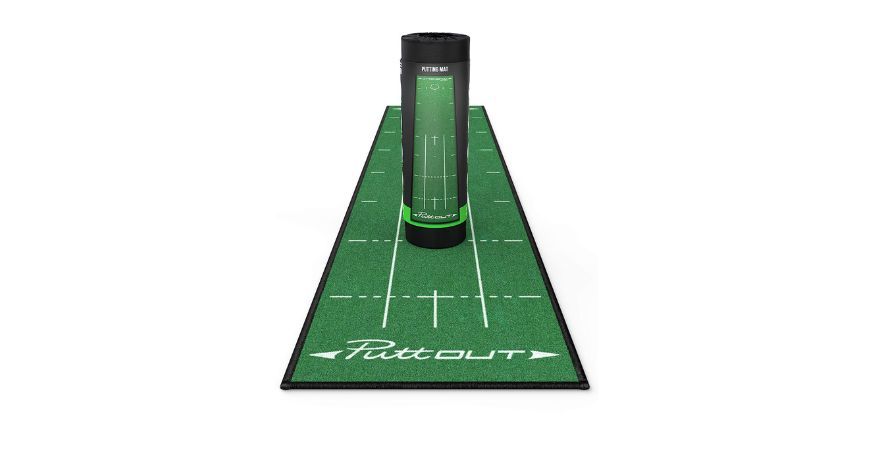
A 240 × 50 cm (about 8 ft × 20 in) putting mat that rolls out on hard floors, reads a stimp of 10, and carries a full set of printed alignment and distance markings — target points at intervals to 6 feet. There is deliberately no hole cut in it: it's designed to be used with a putting cup or a pressure trainer at the far end. The backing is TPR rubber that grips the floor without weights or tape, it rolls up for storage with its own carry case, and it comes in green or grey.
The test that matters: pace
A putting mat lives or dies on one number: does the ball roll at the speed of a real green? Too many home mats are either a lino strip (the ball rockets) or a doormat (the ball dies), and both teach you a stroke that deserts you on the first real green. PuttOut publishes a stimp of 10 — medium-fast, the pace of a decent club green — on a nylon surface, and it holds that number honestly in both colours. That published, verifiable spec is the single biggest reason this mat sits at the top of its category: you are grooving pace, not just direction. Practice on a mat that lies about speed is worse than no practice.
The printed system is the coaching
The markings do more than look technical. Distance markers to 6 feet, alignment lines, and start-line guides turn "hit some putts in the hall" into a session: set up square to a printed line, hit to a printed distance, repeat. From the buyer's side of the counter, the difference between a mat that gets used in April and one that's rolled up by February is almost always whether it tells you what to do next. This one does — it's a drill sheet you stand on.
The honest trade-offs
No hole is a philosophy, and it costs extra to complete. The mat is the surface; the target is a separate piece — a cup, or PuttOut's own Pressure Putt Trainer. Some will call that an upsell. Judged fairly, it's a defensible design: a cut hole in a thin mat never behaves like a real cup anyway, and the trainer's micro-target is a better practice tool. But the honest price of the full setup is the mat plus the target, and a review that hides that is selling you something.
The known flaw: the track. Put in heavy daily sessions on the same line — thousands of putts down the centre — and the pile can lay a visible track that starts to hold the ball's line. It's the one deduction everyone who sells these knows about, and it's why the score isn't higher. Two mitigations, both free: the mat is 50 cm wide specifically so you can move your line and putt the full width of it rather than grooving one stripe, and rotating the mat end-for-end spreads the wear. Used the way it's built to be used, the track is a slow problem, not a fast one.
One practical note: it rolls up well, but a rolled mat needs somewhere to live, and it wants a hard, flat floor — over deep carpet, every mat in this class misbehaves.
What it does well
- A true, published pace. Stimp 10 in either colour — pace practice that transfers to real greens.
- A practice system, not just a surface. Printed alignment and distance guides to 6 ft give every session a structure.
- Built to live in a home. TPR backing grips hard floors, and it rolls away with its carry case when the room has to be a room again.
- Premium without being silly money. CA$139.99 at Golf Town against mats that cost more and publish less.
What it doesn't do
- No hole, by design. The complete setup is the mat plus a cup or pressure trainer — budget for both.
- The centre track. Heavy same-line use lays a visible track over time; putt the width of it and rotate it.
- Hard floors only, really. Deep carpet undermines the roll, like every mat in the class.
Verdict
Buy it if: you practise at home through the off-season and want the surface to tell the truth about pace. It's the mat I'd put a serious improver on, and it's on this site's big gift shelf — for a golfer who practises, it's the rare gift that gets used in January.
Skip it if: you want an all-in-one mat with a cup built in and don't want a second piece — or your only floor space is deep carpet.
Price checked at Golf Town on November 10, 2026 and may change. Same ball, same read: the balls in your bag matter as much as the surface — see the Titleist Pro V1 review, and for the other half of winter practice, the Orange Whip trainer.
My rating: 8.5/10 — an expert evaluation. As a piece of practice equipment judged on its merits: true pace, a real practice system, honest build. The deductions: the target is a second purchase, and the track is the tax on heavy use. Everything else in this category is chasing it.
CA$139.99 at Golf Town
Direct retailer links. Prices were the checked prices at review time; the retailer page always shows today's.