
How this chew has actually lived in my house
Zibi has had these since she was a teething puppy, so I’ve watched the same chew do two completely different jobs. As a puppy, one chew lasted about a day and a half — that was full-time teething work, and it held up to it. At two years old she doesn’t chew them as often, and one now lasts a long time as an everyday chew. I swap in a fresh one every week to week-and-a-half so it doesn’t get gross — that’s the whole rotation. No special system, just a chew that’s out, gets worked on, and gets retired on schedule.
That’s also why I trust my read on the economics below: I’m not extrapolating from a weekend with a sample. This is a chew I’ve bought across my dog’s whole life so far.
What a yak cheese chew actually is
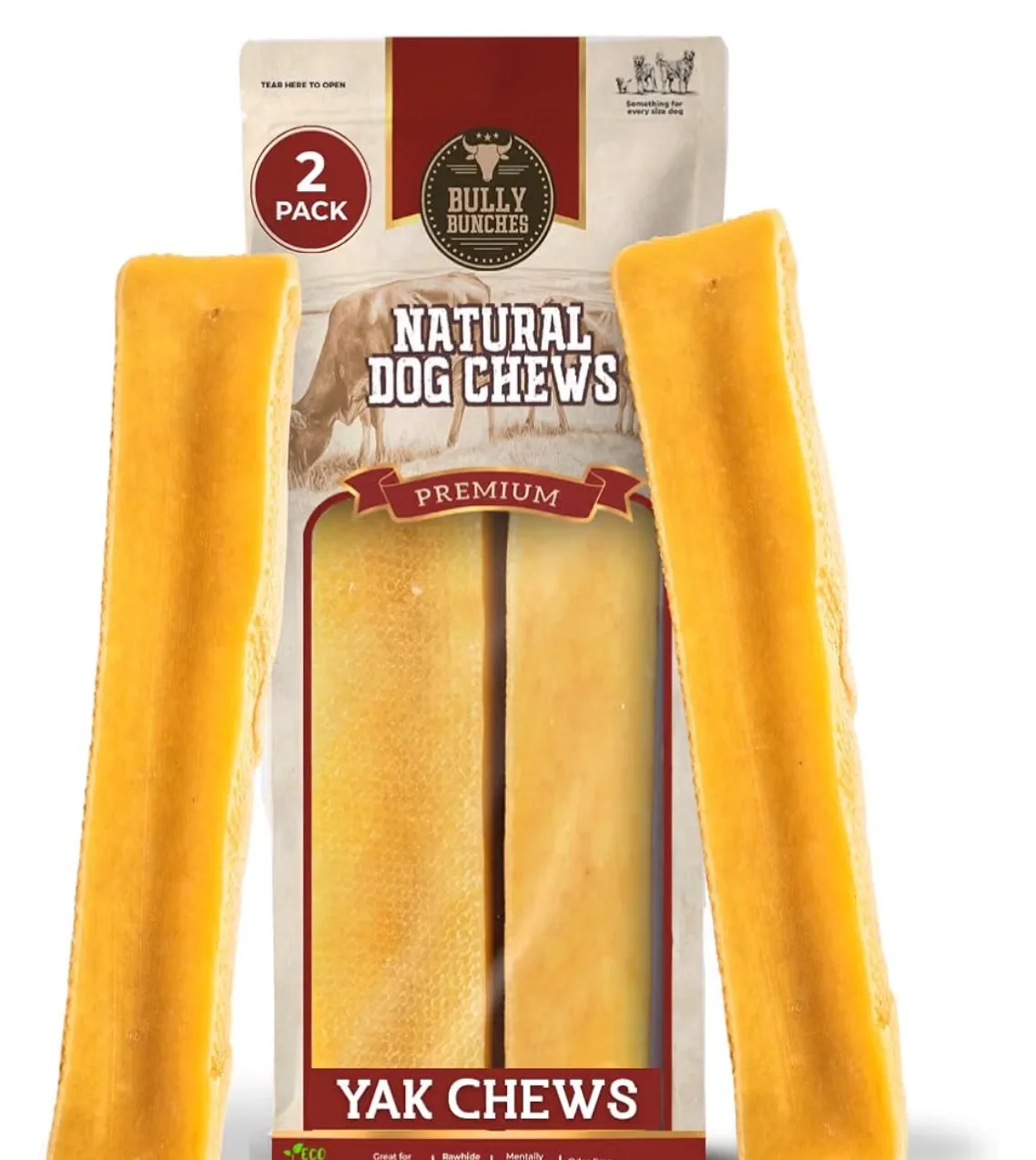
Yak chews come out of a Himalayan tradition: yak and cow milk is boiled, pressed into dense blocks or sticks, and dried until it’s hard — closer to a very firm cheese than to any treat in the biscuit aisle. Two processing facts do most of the selling. First, nearly all the lactose is removed along the way, so “cheese” here doesn’t mean the digestive gamble dairy usually is for dogs. Second, there is no rawhide anywhere in it — the chew softens gradually as the dog works it rather than coming off in sheets, which is the failure mode that put rawhide on so many avoid lists.
Bully Bunches’ version is the large format, aimed squarely at large dogs and heavy chewers, sold two to a pack. It’s also worth noting who sells it: Bully Bunches is a Canadian company, and the brand already anchors this site’s chew coverage with its bully stick rings.
Who this is for
Owners of large, determined chewers who need a chew measured in evenings, not minutes — and who’d rather not pay bully-stick prices at bully-stick speed. For a dog in Zibi’s class — a 35-pound English field gun dog with real chew drive — the large size is the minimum sensible choice; sizing down on a hard chew is false economy and a safety compromise at once.
What it does well
Longevity is the headline, and I’ve lived both ends of it. A hard-pressed yak chew doesn’t dissolve on contact; the dog has to work the surface, soften it gradually, and earn every bit. With a teething puppy that meant about a day and a half of serious work per chew. With a two-year-old who chews less often, one chew stretches across many sessions — managed properly (put it up between sessions rather than leaving it out) it’s a fundamentally different cost shape from a consumable that disappears in a single sitting.
The per-hour economics beat the bully stick. At roughly $28 for the pair, you’re paying about $14 per chew — sticker shock next to a single bully stick, until you divide by hours of occupation instead of by pieces. A bully ring at roughly $5.80 a piece that lasts one honest evening is the more expensive habit. Yak chews invert it: high unit price, low hourly rate.
Odour-free is a genuine household upgrade. Anyone who has lived with bully sticks knows the smell tax. Yak cheese chews are effectively odour-free — the chew can happen in the living room, in company, without commentary. For indoor evening chews, this alone moves the category.
The dental angle is mechanical, and that’s the honest version of it. The hard surface plus sustained gnawing scrapes as it softens — chewing action itself does the work, the same reason any long-format chew gets the “dental chew” label. No miracles claimed; friction and time, applied nightly, are a reasonable plaque-management habit alongside actual dental care.
Ingredient simplicity. Yak and cow milk, processed down, lactose removed, nothing rawhide-derived. For owners who read labels, the short story is the feature.
What it doesn’t do
The end nub is a choking hazard if you let it be — this is the important part. Every long chew ends as a small remnant, and a dog that tries to swallow the last piece whole can choke. The rule is non-negotiable: take the chew away when the remnant is small enough to fit whole in the mouth. The standard recovery, and it’s a good one: soak the nub briefly and microwave it for roughly 30–60 seconds. It puffs up into a crunchy, fully edible treat — the last piece becomes a bonus instead of a bin item. Let it cool completely before it goes back to the dog.
It is not a leave-alone chew. Hard chews demand supervision, full stop. Dogs should be watched with any chew, but a dense cheese stick worked down over days deserves the same attention as the bully sticks it replaces.
Aggressive gulpers should skip it. Dogs that try to break off and swallow chunks rather than gnaw are the wrong audience for any hard-format chew. This is a gnawer’s product.
Premium per-chew price is real. Two chews at the better part of $30 is a considered purchase, and a dog that turns out to be a yak-chew sprinter will burn the economics fast. Buy the first pack as a test, time it honestly, then do your own math.
Dairy caution, stated carefully. The lactose is processed out, which is why these chews suit most dogs that don’t tolerate dairy. “Lactose-free” is not identical to “dairy-free” — a dog with a true milk-protein sensitivity is a different case, and that’s a vet conversation, not a product-page one.
How it compares
vs. Bully Bunches bully stick rings: the rings are the tastier sprint — top engagement, gone in a night or stretched to two, roughly $5.80 a ring and a monthly habit with a real number attached. The yak chews are the marathon from the same Canadian company: slower engagement curve, no smell, several sessions per piece, cheaper per hour. The sensible chew drawer has both — rings for the occasion, yak for the rotation.
vs. rawhide: not a contest this site will entertain. Rawhide’s chunk-and-swallow failure mode is exactly what the pressed-cheese format avoids.
vs. antlers and bones: harder still, and hard in the way that cracks teeth. Yak cheese sits a deliberate notch softer — hard enough to last, workable enough to soften. For most heavy chewers, that middle hardness is the point.
Verdict
Buy it if: you have a large or heavy-chewing dog, you’re tired of paying per-evening for chew time, and you’ll supervise and manage the rotation — including rescuing the end nub for the microwave trick. The longevity economics, the odour-free evenings, and the simple ingredient story all hold up, and 500-plus buyers a month with a 4.4-star average suggest the format delivers for most who try it.
Skip it if: your dog gulps chunks instead of gnawing, if the chew would be left out unsupervised, or if a sub-$30 two-pack fails your household math before the per-hour argument gets a hearing — in which case the bully stick rings remain the better-understood splurge.
The yak chew doesn’t replace the bully stick; it corrects its economics. Same company, same dog, longer clock.
Price shown is the Amazon.ca price at review time and may change.
Related reviews: Bully Bunches Bully Rings — the tastier sprint from the same Canadian company · KONG Classic — the other long-haul chew in the rotation.
Tested: Both — in the city and up north.
My rating: 8.5/10