
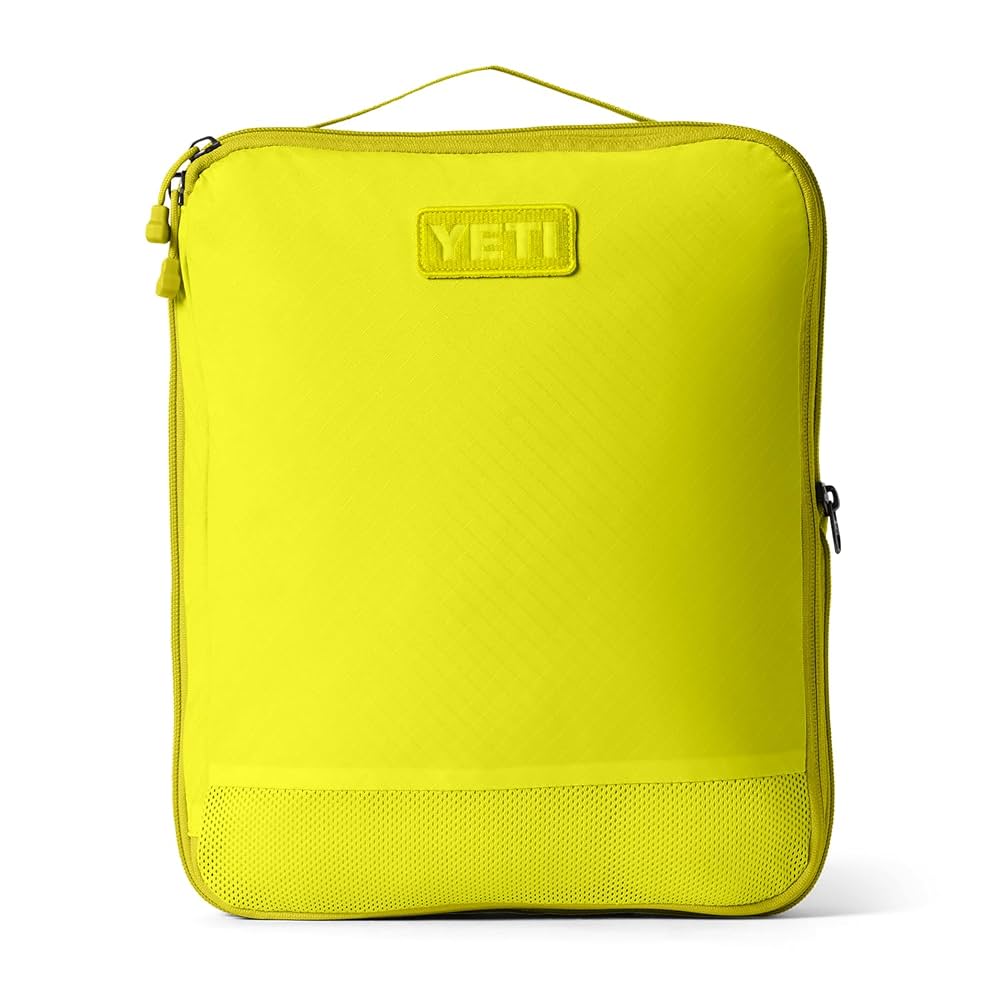
Packing cubes are the least glamorous gear I own and possibly the hardest-working. YETI’s Crossroads cubes come in three sizes — Small, Medium, Large — each a structured, soft-sided box with a wrap-around expansion zipper: load it full, zip the second zip, and the cube compresses down, squeezing the air and the bulk out of your clothes. They hold their shape empty, which sounds like nothing until you’ve tried to pack a floppy cheap cube at 6 a.m.
I own ten of them. Four Large, three Medium, three Small. All bright yellow — a colour I did not choose on purpose, and now would not change. More on that below, because it turned into actual buying advice.
Why I’m qualified to judge a packing cube
These cubes have done real miles. They’ve crossed the city-to-up-north run more times than I can count, and they’ve flown — Florida, Mexico, long-haul carry-on trips where a bag has to be a system or it’s a swamp. They live inside my YETI Panga (reviewed on this site, 9/10) as that bag’s whole internal organization, and they survived the comparison that matters most: I owned the cheap version first.
The story starts with an inexpensive experiment. I bought a cheap cube set off Amazon to see whether packing cubes were even a thing I liked. The system? Loved it immediately. The material? Not built for my life — thin, floppy, the kind of thing that feels like it’s quietly planning to fail at an airport. So I upgraded to the YETIs, and the YETIs are the ones still in service. If you’ve read my sunglasses review, you know this pattern. I test cheap, I buy once, and then I keep the good version for years.
How I actually pack
The system is categories, not chaos. Each cube has a job:
Dog clothes — the dog-park and dog-walk kit for Zibi, my 35-pound English field gun dog, rides in its own cube. Wet, muddy, or clean, it never touches my clothes.
Outdoor clothes — the shoreline and trail layers.
Warm clothes — the insulation layer of the trip.
Day-to-day outfits — the regular clothes, packed by day or by outfit on longer trips.
Dirty laundry — yes, a cube becomes the laundry bag on the way home. Separation works in both directions.
The math that matters: a Panga load is roughly three full Large cubes, or two Large plus two or three Medium. They slide right into the Panga like they were designed for it — because dimensionally, they basically were. For bigger trips the same cubes move into a larger carry-on and scale up by days and outfits instead of categories. Nothing about the system changes; only the bag does.
The Large earns its keep. A full jacket fits in one — an actual jacket, not a t-shirt making promises — and once the compression zip closes, the space saving is real, not marketing. Coats and bulky layers are exactly where cheap cubes give up; this is the size I reach for first, and the four I own get used four-deep.
The Small is not a clothes cube — and that’s the point
Here’s the honest expectation-set, because it’s where a buyer can go wrong: the Small is small. Genuinely, read-the-dimensions small. If you order Smalls expecting to pack outfits in them, you’ll be disappointed, and it will be partly your fault and partly every product photo ever taken. Check the actual dimensions on the listing before you order, and don’t over-buy Smalls on your first order — one or two will tell you if the size fits your life.
Because once you stop asking the Small to be a clothes cube, it becomes the most-used cube I own. The Smalls are my everyday loose-item organizers:
One rides in my YETI Sidekick Dry — cords, chargers, and the small loose things that otherwise migrate to the bottom of the Panga and vanish. It’s the Sidekick’s inner organization, part of the carry I use constantly.
One lives in my gym bag as a medical kit — band-aids, headphone charger, headphones, the small essentials that need a home that isn’t a pocket.
Toiletries and tech — toothbrushes, cords, anything that “doesn’t have a home” gets a Small, and then it has one.
Framed that way, the Small isn’t the weak size. It’s a different tool: an everyday-carry organizer that happens to share a product line with two clothes cubes.
The colour story — buy the loud one
I originally wanted a muted colour. Tasteful. Disappears into the bag. What was available was bright yellow, so bright yellow is what I got — and I’m now a convert, on the record: buy the bright colour on purpose.
A bright cube is harder to lose, and not just in the dark. It’s mid-pack with gear spread everywhere, reaching into a black duffel interior, a cube that’s slid under a hotel bed — the yellow one announces itself; the muted one plays hide-and-seek with your morning. Bright blue works the same way. The listing’s colours are Royal Blue and Stag Red; mine are the yellow. Tidy-looking is a property of a photograph. Findable is a property of a trip.
What it does well
The system ends bag soup. Everything has a cube, every cube has a category, and I can find the warm layer in the dark without unpacking the trip onto the floor. Packing went from a chore I improvised to a routine I repeat.
The compression is honest. Load, zip, compress — bulky clothes genuinely take less room, and the structure means the cube behaves like a soft box instead of a pillow. A full jacket in a Large, zipped down, is the demonstration.
The material is the upgrade. This is the whole reason the YETIs replaced the cheap set: they feel like gear — they hold form empty, the zippers run like they mean it, and after years of being yanked out of duffels and thrown in trucks, they still look and work like the set I bought. Cheap cubes are a subscription. These were a purchase.
They scale across every bag I own. Panga for overnights and weekends, a larger carry-on for flights, one Small moonlighting in the gym bag. Same cubes, three jobs.
What it doesn’t do
The price is a multiple of the cheap sets — and should be said plainly. CA$35 to $45 per cube means my ten-cube fleet cost real money, and a no-name set costs a fraction of one YETI cube. My defence is the same one I make for the sunglasses: I bought the cheap version first, it wasn’t durable enough, and I replaced it once. If your travel is two flights a year, the cheap set may honestly be enough. If your bags work for a living, the math flips.
The Small will surprise you if you skip the dimensions. Repeated here because it’s the one mistake a reader can actually make: it’s pretty small. Organizer, not outfit cube. Buy accordingly.
One system, one more thing to wash. Cubes that carry dirty laundry earn their keep but need an air-out like anything else. Minor, but nobody else will tell you.
Who this is for
Anyone whose travel runs on a duffel or a backpack — overnights, weekends up north, flights where the carry-on has to behave — and who is tired of unpacking the whole bag to find one layer. Dog people especially: a dedicated cube for the dog’s gear is the single easiest upgrade in this whole system. If you travel once a year with a roller suitcase and a garment folder, save your money. If your bag is your basecamp, this is basecamp furniture.
Verdict
Buy it if: you pack by trip, not by hope; your main bag is a duffel or backpack (Panga owners, especially); and you want to buy the durable version once. Start with Large and Medium for clothes, add one Small as an organizer, and pick the bright colour without embarrassment.
Skip it if: you need your packing cubes to hold outfits at every size including Small, you travel light and rarely, or the premium over a cheap set buys you nothing because the cheap set would live an easy life. It happens. It just isn’t my life.
Ten cubes, three sizes, one loud colour, and a system that has survived the city, up north, and two countries’ worth of airports. I started at 8.5 in my head and talked myself out of it the same way I did with the Panga: I’m very happy I have them, and happiness with gear you use this often is the whole test.
Prices shown are the Amazon.ca prices at review time and may change.
Related reviews: YETI Panga Backpack — the bag these cubes organize; a Panga load is roughly three Large cubes, or two Large plus two or three Medium · YETI Sidekick Dry Gear Case — where one of the Smalls lives.
Tested: Both — in the city and up north.
My rating: 9/10 — the docks: the Small’s size will catch out anyone who doesn’t read dimensions, and the price asks real money for what looks like a simple box. What it earns back is everything else — the system, the durability, and the fact that the cheap version is gone while these are still packing.
CA$35 (Small) · CA$40 (Medium) · CA$45 (Large) on Amazon.ca
Direct retailer links. Prices were the checked prices at review time; the retailer page always shows today's.