
Why I'm qualified to judge a nylon chew
The chew shelf splits into two categories that get bought as if they were one: things a dog eats, and things a dog chews. Everything else in this site's chew coverage is edible — bully sticks, yak chews — and edibles grade on ingredients, sourcing, and how long they last. A durable nylon chew grades on completely different criteria: material behaviour under sustained jaw pressure, what the failure mode looks like when it comes, and whether the product's safety discipline is one a real owner will actually follow. That's a procurement evaluation — spec, failure mode, and total cost of getting it wrong — and the cost of getting this one wrong is a fractured tooth and a vet bill that dwarfs the toy. So this review is written the way the category deserves: the safety math first, the chew second. One disclosure before it starts, because the hands-on label needs qualifying on this one: we bought the Wishbone when Zibi was teething — and she barely chewed it. She has never been a big chewer, and a hard nylon chew never made her list, so our trial was a limited one: a teething puppy who turned out not to be this product's audience. The recommendation below is made with that qualification printed on it — judged on design, materials and the manufacturer's safety discipline, and aimed at the dogs this chew was actually built for: teething dogs and committed, strong chewers. Our dog just wasn't one.
Who this is for
The owner of a determined, food-motivated chewer who burns through edible chews in minutes and needs a daily-driver chew that lasts weeks, not sittings. The Medium size band (dogs under 60 lb) covers a 35-pound field dog squarely, with room to size up — which, per the safety rules below, is the right instinct. It is not for anyone looking for an unsupervised crate toy, and not for a dog with existing dental damage or a slab-fracture history without a vet's say-so first. And a gentle-chewer caveat from our own toy box: a dog who isn't a chewer may simply ignore it — ours did. (For young puppies, Benebone's own guidance points to its separate, softer puppy line; the adult chews here are for adult teeth.)
⚠️ The tooth-safety math — read this before the good parts
Nylon is hard. That's the product: a chew that survives weeks of aggressive chewing has to be made of something that barely yields, and what barely yields to a dog's jaw also barely yields to a dog's teeth. The classic injury is a slab fracture of the upper fourth premolar — the big carnassial tooth at the back — where chewing force shears a slab off the tooth, often exposing the pulp. It is one of the most common significant dental injuries vets see from chew toys, it is painful, and the fix is extraction or a veterinary root canal — a bill measured in thousands, not chew-toy dollars. Veterinary guidance is consistent on the rule that follows: if you can't dent it with a thumbnail, it's hard enough to break a tooth, and nylon sits squarely on the wrong side of that line.
None of that makes Benebone a bad product. It makes it a conditional one, and the conditions are the manufacturer's own:
- Supervise, always. This is a chew-with-you-present product, full stop.
- It is not food. Normal chewing should produce nothing bigger than rice-sized shavings. If your dog can bite off chunks, the chew is the wrong size or the session is over.
- Retire it on schedule. When the ends wear down, it goes in the bin, not back in the toy box. A worn Benebone is where pieces come off.
- Size up, not down. A dog between sizes gets the bigger chew.
- Ask your vet if your dog has any dental history at all.
An owner who runs that discipline gets a genuinely excellent chew. An owner who won't should buy something softer and accept the shorter life.
What it does well
- Flavour through the material, not on it. Real flavour — bacon, chicken, peanut, real maplewood in the Maplestick, jack salmon in the Fishbone — infused all the way through the nylon. There's no coating to wear off, so the taste in week three is the taste from hour one.
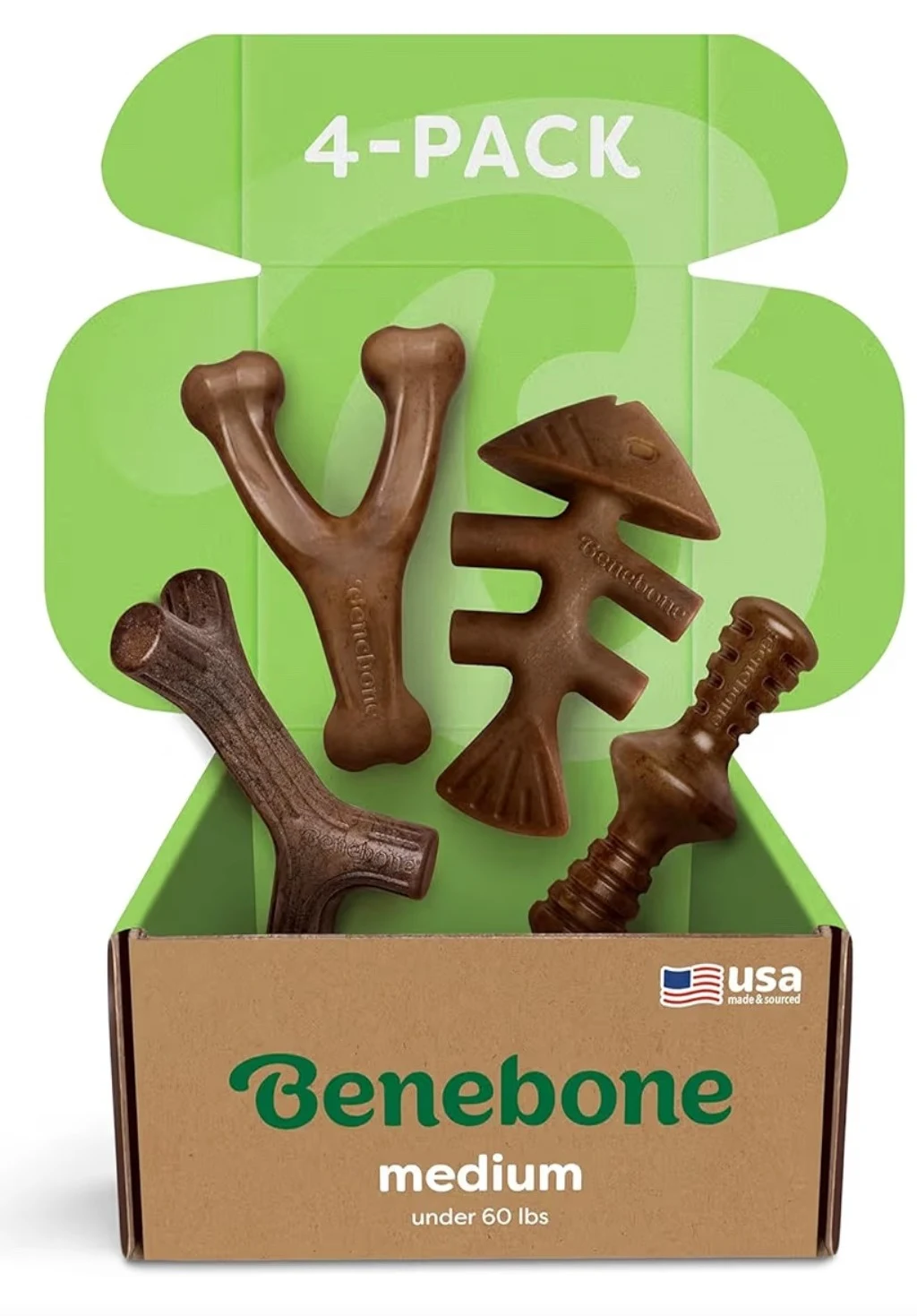
- Shapes that are grip engineering. The Wishbone's curve lets a dog pin the chew between her paws and hold a working angle; the Zaggler rolls for dogs who like a moving target; the Maplestick mimics a stick without the splintering. Four shapes in the 4-Pack is a rotation, not variety packaging.
- It lasts like the category promises. Weeks per chew, replaced on wear rather than consumed — on cost per hour of occupation, the cheapest serious chew we can point at, inside the safety discipline.
- Made in the USA, with a happiness guarantee. A manufacturer who answers for the product, in a category full of anonymous listings.
- The demand signal is real. Amazon's Choice on Amazon.ca, the #1 spot in Dog Chew Toys, 4.5 stars across more than 18,000 ratings. This is the name brand of its category.
What it doesn't do
- Remove the risk it creates. The density that makes it durable makes it tooth-hard. No design feature fixes that; buy it with eyes open or don't buy it.
- Last forever. It sheds small shavings in normal use and wears by design — a power chewer on the daily rotation is a recurring purchase, just a slower one than edibles.
- Feed or clean. No food value, and this review makes no dental-health claim for it — given the fracture risk runs the other direction, that would be a strange claim to print.
How it compares
vs. the edible cluster (Bully Bunches rings, bully sticks and yak chews — reviewed on this site): different jobs. Edibles are the high-value event — fully consumed, priced per sitting, done in minutes to an hour for a serious chewer. Benebone is the standing equipment that's simply there every day, priced per month. A complete chew drawer has both; Benebone fills the hours between edibles, it doesn't replace them.
vs. the KONG Classic (reviewed on this site): rubber versus nylon, and the material difference is the safety difference. The KONG yields and flexes under the jaw; the Benebone is the purer, harder, longer session that demands a supervisor. For a dog with any dental question marks, the KONG's forgiveness wins. For a sound-toothed power chewer whose owner is present, the Benebone outlasts it by weeks.
4-Pack vs. Wishbone single: the Wishbone alone is the trial — it's the one we bought — one shape, lowest entry cost (CA$15.19), find out whether your dog takes to nylon and whether you'll run the supervision discipline. The 4-Pack is the commitment buy: four shapes for rotation at CA$40.43 — about CA$10.11 a chew, well under buying singles. That math makes the pack a good deal if you really have a dog that was chewing a lot — or a good gift for somebody whose dog is. First-time buyers start with the Wishbone; owners replacing a worn Benebone buy the pack.
Verdict
Buy it if: your dog is a sound-toothed, food-motivated power chewer; you'll supervise every session and retire the chew on wear without being reminded; and you want the daily-driver chew that ends the per-sitting edible spend for routine chewing hours.
Skip it if: you want an unsupervised toy, your dog has any dental history you haven't cleared with a vet, or the supervision-and-retirement discipline sounds like homework you won't do — in that case the honest move is a softer chew and a shorter lifespan, not this one and crossed fingers.
Related reviews: KONG Classic Dog Toy — the forgiving rubber alternative · Bully Bunches Bully Rings — the edible end of the chew drawer · Bully Bunches Yak Cheese Chews — the other long-lasting chew.
My rating: 8/10 — a point and a half comes off for the tooth-safety reality no nylon chew escapes: the category's best-executed product still carries a fracture risk the owner has to manage every session, for the product's whole life. Within that condition, this is as good as durable nylon gets. The caveat isn't a footnote to this recommendation; it is the recommendation's terms.
CA$40.43 for the Medium 4-Pack on Amazon.ca · Wishbone single CA$15.19
Direct retailer links. Prices were the checked prices at review time; the retailer page always shows today's.